
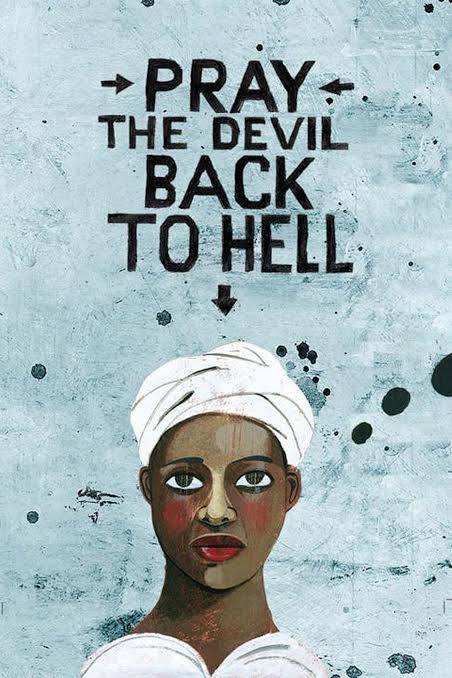
Pray the Devil Back to Hell is an uplifting documentary film founded on the true story of a group of courageous Liberian women, led by Leymah Gbowee, who united across religious and social lines to put an end to Liberia’s ruthless civil war. Their peaceful campaign not only helped bring about the resignation of then-President Charles Taylor, but also paved the way for the election of Africa’s first female head of state, Ellen Johnson Sirleaf. The film is an uplifting homage to the power of grassroots, women-led activism in the face of violence, impunity, and political apathy.
The Liberian conflict was based on deep-seated issues, economic disparities, corruption, ethnic rivalries, and the disintegration of state institutions. Years of political unrest erupted into civil war when Charles Taylor took over in 1997 after a violent struggle. The country plunged into chaos as Taylor’s regime and various rebel factions (most notably LURD) used terror to gain control over territory and resources, particularly diamonds and timber.
The violence soon escalated. Children were forced to fight as soldiers, women were raped systematically, and entire communities were displaced. Men were either forced into armed factions or killed, and women and girls were forced into sexual slavery. Children had their childhood taken away as they were forced either to fight or fend for themselves in refugee camps. Gender-based violence was being used as a weapon of war. The state had collapsed, and in the absence of the rule of law, Liberians were trapped in a constant nightmare.
The main actors in the conflict were Charles Taylor’s government, the rebels, and the civilian population that suffered. While the political elites clashed over power and wealth, it was ordinary people, and women especially, who bore the heaviest burden.
In the midst of this despair, Leymah Gbowee, a social worker and mother, was devastated by the suffering around her. A dream, in which she was forewarned of the destruction of Liberia, became a spiritual and moral awakening. It occurred to her that if no one took action, nothing would ever change. Her pain was turned into a mission: to organize a movement of women demanding peace.
She began by organizing women from her Lutheran church, calling on them to pray and to act publicly. She cast peace, nonviolence, and motherhood as the ethical foundations of their movement. The women wore white, which was a symbol of peace, and they conducted silent sit-ins and public prayers.
Understanding the need for unity, Leymah reached out to Muslim women leaders. Though the population of Liberia was divided along religious lines, women of every religion suffered alike. Christian and Muslim women united and formed the Women in Peacebuilding Network. Women used simple but powerful tools: prayers, songs, mass protests, and even a sex strike to pressure their husbands and partners into taking peace seriously.
The movement’s strategy was nonviolent yet relentless. Theirs was a strategy of moral authority, collective strength, and spiritual imperative. Their message was clear and emotionally evocative: “We want peace, no more war,” and “The future of our children is at stake.”
As the women’s movement grew, it could no longer be dismissed. The women protested daily in front of government buildings and eventually secured a meeting with Charles Taylor himself, demanding peace talks with the rebels. They shoved the parties to the negotiating table in Ghana.
Despite their key role in initiating the peace process, however, the women were not formally asked to participate in the negotiations, excluded by patriarchy and political elitism. But they would not be quiet. Resorting to a dramatic move, hundreds of women surrounded the building where peace talks were ongoing and locked the delegates inside, warning that they would not be allowed out unless an agreement was signed. This physical and moral pressure prevented the breakdown of negotiations.
Since the negotiations were slow due to political egos, mistrust, and individual interests the women kept vigil outside. Their presence helped to remind the negotiators that they had a responsibility to the people. Through insistence and public visibility, the women ensured that the negotiations made tangible progress towards peace.
After the peace agreement, Liberia was faced with the enormous challenge of reconstruction. The disarmament, demobilization, and reintegration (DDR) process had to be carefully managed, especially with thousands of child soldiers and traumatized combatants. Women were at the center of healing the communities, trauma counseling, reintegration activities, and safe spaces for former fighters, especially children.
The United Nations was involved in the management of the DDR process but was consistently criticized as being slow, too bureaucratic, and removed from the local context. Women’s organizations filled these gaps, using empathy, trust, and solid communal ties to accomplish what international actors could not.
To prevent the return to war, women focused on political stability and civic engagement. Women mobilized the voters, monitored the 2005 elections, and campaigned for the presidency of Ellen Johnson Sirleaf. Her election as Liberia’s first woman president was a historic moment, proving that women’s leadership was not only desirable, but essential for peace.
The women carried forward a message of reconciliation, justice, and a shared future. Their narrative is the heart of the Women, Peace and Security (WPS) agenda, as established in UN Security Council Resolution 1325: women must be part of all peace processes not as victims, but as agents of change.
Pray the Devil Back to Hell is more than a documentary, it is a testament to the courage, intelligence, and moral leadership of women in the midst of conflict. It demonstrates that peace is not simply the silence of war, but the active pursuit of justice, inclusion, and healing. Through the courage of women like Leymah Gbowee and the thousands of women who stood with her, Liberia shows the world: durable peace is possible only when women sit at the table.