Unveiling the Political Edicts as Feminist Weapons: The rising of women ulama in Indonesia. Echoing the vibrant of Islamic feminism through transformative political assertion.
On 20 November 2023, the Indonesian Congress of Women Islamic Scholars (Kongres Ulama Perempuan Indonesia – KUPI) network collaborated with the Centre Studies of Gender and Children (Pusat Studi Gender dan Anak – PSGA) Universitas Islam Negeri Hidayatullah Jakarta conducted a discussion forum and declare the Political Edicts of Women Scholar – Maklumat Politik Jaringan Ulama Indonesia. This event was held hybrid scheme with the theme “Clean and Dignified Election for a Just Civilization” and attended by more than 250 participants. This initiative revealed the strategic women’s role in responding to the political year in Indonesia.
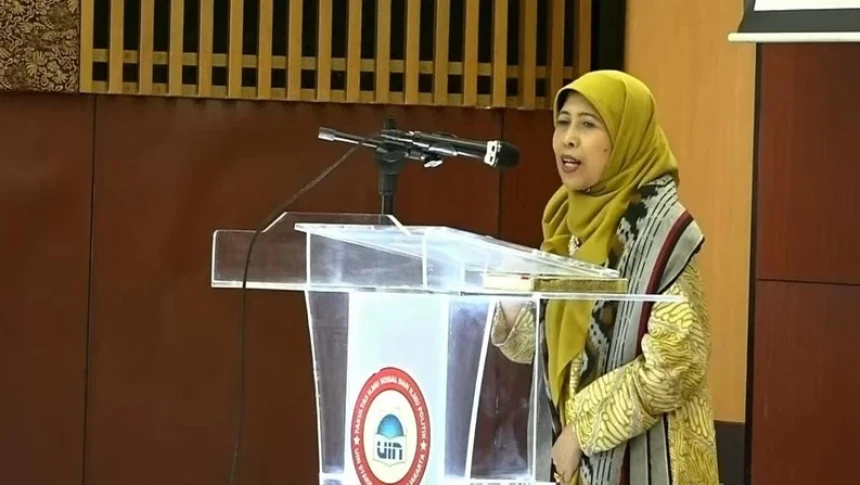
In her speech, Ny. Hj. Badriyah, the leader of the KUPI Consultative Assembly, encourages the KUPI members and all the civil society elements to ensure the election in 2024 is implemented within the norms and in an appropriate manner (makruf). This principle must be followed for obtaining democracy and blessing elections for all nations not only for specific political actors. Afterward, all KUPI members read the five points of the decree in response to the Indonesian political situation. The first maklumat emphasized the nation’s noble ideals and enforced to upholding of human rights and the principle of state sovereignty. Second, the makruf norms and processes should be implemented in the election. All agendas to weaken democracy cannot be justified. Third, encourage women’s participation and representation in all aspects of organizing elections, in order to have dignity and integrity, so as to realize a civilization of justice. Fourth, continue to strengthen, maintain, and nurture the working power and movement of civil society to ensure that a true democratic process takes place. Fifth, Indonesian Muslim women scholars are determined to make a leadership contribution to participate in guarding the true democratic process.
From those edicts, the KUPI not only declared its position in the Indonesian political constellation, but also to some extent it will escalate the transformation of Islamic feminism in Indonesia. According to Haideh Moghissi, Islamic feminism is used to differentiate certain feminist agendas of women’s Muslim activities to reform women’s interest in social life and legal prescriptions that regulate the Muslim communities. The reality of reforming the rigid religious and social-culture practice is to find the strategies to attain equality and justice. Moreover, Nor Ismah argues women Muslims in Indonesia play a significant role as Islamic scholars (ulama) either in the public sphere or at the grassroots level. Even though their contributions were usually neglected by men, women had a religious authority as men to declare fatwas. Their authority is based on the local community’s sensitivity and knowledge. However, the KUPI forum escalated the national network of women ulama in Indonesia. It seems to bring a new atmosphere for the women Muslim feminists in Indonesia to advance gender leadership equality.
Through this KUPI edicts for the election in 2024 will be a milestone in the political transformation of Islamic feminism in Indonesia. To some extent, this movement can be achieved because of the power of the women’s ulama network in Indonesia through the platform KUPI. In other words, transforming Islamic feminism requires the bottom-up structural network of women’s agency. They were positioning their self as men who could play a crucial social-culture aspect of life to create a fatwa. In the previous conference KUPI event, they proposed the fatwa regarding the marginalization of women protecting the Republic of Indonesia from the dangers of violence in the name of religion, and the issue of protecting women from the danger of forced marriage.
Ahead of the Indonesian election year, is a promising moment for the KUPI to transform and strengthen its position to play a crucial role in political constellations. It is proven that the edicts not only emphasized the goal and the principle of democracy but also encouraged more women representatives in politics and the significant role of Muslim women’s leadership in maintaining the democratic process. It means not merely the concepts of the Islamic feminist movement but also the noble ideals for Muslim women to involve themself in reforming the religious rigid about the participation of women in the political constellation.
There is a possibility that this Political Edicts of Women Scholar can increase the chance of filling in the gender quota in Indonesia. As the experience, from the previous election only around 13,3% in 2014, and 20,5% in 2019. However, it will be impossible to obtain if there is no political education for Muslim women. Since the political constellation in Indonesia regulates that the candidate should be part of the party, Muslim women who want to represent their religion should join the party. To facilitate or encourage their representative candidate in 2024, the KUPI must consider this scheme or announce a fatwa that it is not terrible to join the political party. If the next election attains the gender quota, it will be hard to deny that the Muslim women’s edicts contribute to it.
Moreover, reflecting the cruel latest election that resulted in massive social cleavage because of the polarization in politics. The member of KUPI must propose a strategy to maintain election peace as in their edicts. They should create a technical guidelines strategy to educate and warn Muslim women to maintain the political issue during the election period.
In conclusion, the Political Edicts of Women Scholar will bring a new atmosphere to the political dynamic in Indonesia. How those edicts will work depends on the follow-up action of the members to realize in the next year. However, this step demonstrated the notion of the political transformation of Islamic feminism in Indonesia.
Source of image: https://images.app.goo.gl/qKdWrB2FHJgVvH6HA